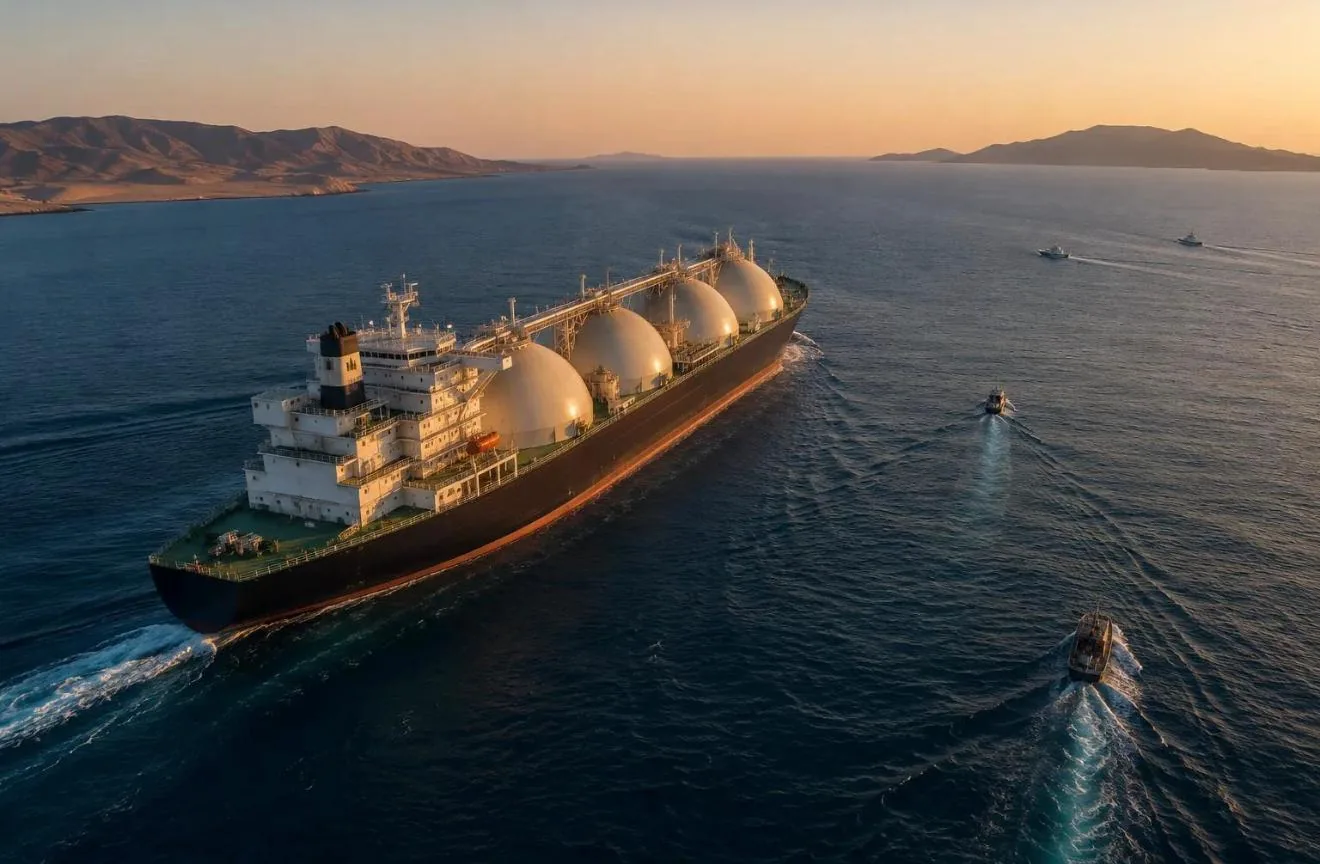
From Doha, Europe’s energy crisis takes on an entirely different dimension. Thousands of kilometres from Paris, in Qatar’s gas facilities and in the narrow waters of the Strait of Hormuz, part of French purchasing power is being decided today. A reality we still too often look at as a distant affair. It no longer is.
When the Strait of Hormuz trembles, French energy bills move as well. The sentence may sound excessive. It is not. In France, when we talk about the price of gas, we naturally look at our bill. We notice a few extra euros, a monthly payment that rises, a winter that may cost more. We ask what the government is doing, what Brussels is deciding, or why our supplier is raising its tariffs again. But behind those few euros now lies an immense geopolitical chain that links our apartments in Paris, Lyon or Marseille directly to Qatar’s gas fields, to the LNG carriers crossing the oceans, and to that narrow strip of sea separating Iran from the Arabian Peninsula: the Strait of Hormuz.
Since I have been living in Doha, this reality strikes me even more forcefully. Because here, energy is obviously not an abstract subject. It is everywhere. It structures the country’s economy, its international relations, its diplomacy and part of the world’s strategic balances. And above all, when you look at the situation from the Gulf, you understand how Europe sometimes has this strange habit of discovering its dependencies only when a crisis breaks out.
What this rise actually says
The figures speak for themselves. On 1 September, France’s benchmark gas price rose by 5.6% in a single month. Since April, the increase is close to 24%. For the roughly six million households whose contract is indexed to this benchmark price, the consequence is starting to become very concrete. For a gas-heated home consuming about 10,000 kWh a year, the level reached in September represents, over a year, about one hundred euros more than the previous tariff. One hundred euros. For some households, that remains absorbable. For others, who are already adding up food, housing, transport and electricity, it counts.
But what interests me most is what this increase tells us. Because it is not only about energy. It is geopolitical. Since the war in the Middle East began at the end of February, energy markets have been violently shaken. According to the French Treasury, between February and March the price of Brent jumped by 43% and that of European gas by 45%. Why? Because the Strait of Hormuz found itself at the heart of the crisis.
Hormuz is not simply a name heard on the television news when Iran is mentioned. It is one of the world’s energy arteries. Before the crisis, about one fifth of global trade in liquefied natural gas, LNG, passed through this waterway. Now imagine an artery of that importance becoming blocked. Gas does not, of course, disappear immediately from French boilers. Reserves exist. Other producers can supply part of the volumes. Traders look for new cargoes. States can draw on their stocks. But everyone starts looking for the same product at the same time. And when a product becomes scarcer while several continents need it, its price rises. It is as simple — and as brutal — as that.
Qatar, and Europe’s paradox
This is where Qatar enters the picture. In France, Qatar is known through its investments, sport, its diplomatic role and its growing presence on the international stage. What is measured far less, and yet constitutes one of the foundations of its power, is liquefied natural gas. Qatar shares with Iran the gigantic North Field/South Pars reservoir, considered the largest gas field in the world. For decades, the country has developed an LNG industry, infrastructure and a maritime fleet capable of supplying economies thousands of kilometres away.
And it is already preparing the future. Through the various phases of the North Field expansion, QatarEnergy plans to raise its LNG production capacity, historically about 77 million tonnes a year, to 142 million tonnes a year by the end of the decade. These figures may seem abstract. They absolutely are not. Because behind these millions of tonnes, part of Europe’s energy security is at stake.
Since Russia’s invasion of Ukraine in 2022, Europe has sought to reduce massively its dependence on Russian gas delivered by pipeline. It was a major strategic decision. But leaving one dependence does not mean becoming independent. It can also mean shifting that dependence. And that is precisely where one of the great paradoxes of European energy policy begins.
To replace part of Russian gas quickly, Europe turned massively to liquefied natural gas. And principally to the United States. In only a few years, the United States became by far the European Union’s leading LNG supplier. Their weight in European imports has increased considerably since 2021. In the second quarter of 2026, 63.2% of the LNG imported by the European Union came from the United States. Nearly two cargoes out of three.
That figure alone should open a debate. Because behind this new dependence lies a contradiction we sometimes prefer not to look at. A significant share of American gas comes from shale formations exploited in particular through hydraulic fracturing. Yet France banned hydraulic fracturing on its territory in 2011. In other words, we decided that this technique should not be used at home, notably because of its environmental risks, but we now import on a massive scale gas that comes from an American energy system that relies on it extensively. The paradox is, to say the least, striking.
But it does not stop there. This gas must then cross the Atlantic. Before that, it has to be carried to a liquefaction plant and cooled to about –162 °C in order to reduce its volume considerably. It is then loaded onto an LNG carrier. The ship crosses the Atlantic. On arrival in Europe, the LNG is unloaded at an LNG terminal, then regasified before it can be injected into the network. Extraction, transport, liquefaction, the Atlantic crossing, regasification: all these operations obviously have a cost. They also consume energy.
It would, however, be inaccurate to claim that American LNG is systematically more expensive than every other source of gas: prices vary according to contracts, market conditions and periods. But the underlying question remains: have we really gained in energy sovereignty if we have simply replaced one excessive dependence with another?
In the emergency of 2022, buying American LNG on a massive scale allowed Europe to offset quickly part of the fall in Russian supplies. It was a response to a crisis. But must an emergency solution become a permanent model? The question at least deserves to be asked.
Twenty-seven years, and a strait to cross
This is precisely where the relationship with Qatar takes on its full meaning. In October 2023, QatarEnergy and TotalEnergies signed two agreements providing for the delivery to France of up to 3.5 million tonnes of LNG a year for twenty-seven years. Deliveries are due to begin in 2026, at the Fos Cavaou LNG terminal in the south of France.
Twenty-seven years. On the scale of energy, that figure says almost everything. When Paris and Doha talk about gas, they are therefore not reasoning only about next month’s price. They are reasoning over several decades. A contract of that length will outlast several French governments, several presidents of the Republic, and probably many international crises. That is precisely what energy security means: anticipating, diversifying, building lasting relationships, and above all not waiting for a crisis to break out before discovering that one depends too heavily on a single supplier or a single supply route.
But the current crisis also reminds us of another reality. You can own gas. You can have immense infrastructure to liquefy it. You can have customers ready to buy it. You still have to be able to ship it. And Qatar’s geography is implacable. To reach European or Asian markets, Qatari LNG carriers must pass through the Strait of Hormuz. There is no gigantic pipeline that quietly bypasses this zone and sends the same volumes to Europe.
That is why what happens across a few dozen kilometres of sea can end up, a few weeks or a few months later, on a French household’s bill. And we currently have a full-scale demonstration of it. QatarEnergy has had to extend force majeure notices concerning certain LNG deliveries. Some European and Asian customers are affected. This is therefore no longer only a theoretical hypothesis. The geopolitical crisis becomes a logistics crisis. The logistics crisis affects the market. And market movements end up touching the real economy.
A maritime map
This is probably one of the main lessons of recent years. For a long time, our gas security was drawn essentially on a map of pipelines. Today, it is also drawn on a maritime map. We have replaced part of the pipelines with LNG carriers. And with them, new vulnerabilities have appeared.
A conflict in the Middle East can push European prices up. A disruption of the Strait of Hormuz can sharply reduce global LNG supply. A rise in Chinese or Asian demand can increase competition for available cargoes. An American decision on its capacity or its export policy can have consequences for the European market. Our energy security therefore now depends on events that sometimes take place several thousand kilometres from our borders.
This is another essential point: when an LNG cargo is available on the world market, France and Europe are obviously not the only ones who want it. There is China, Japan, South Korea, India and many Asian economies whose energy needs continue to grow. Part of the world’s energy contest is therefore played out between continents. When supply falls, everyone tries to secure their supplies. Prices rise. And cargoes become strategic.
This is also why the massive increase in Qatari capacity in the coming years matters for Europe. The more the world market has major suppliers and additional capacity, the more consuming countries will be able to diversify their sources of supply. Because real energy security does not consist in choosing a single supplier supposed to replace all the others. It consists precisely in depending excessively on no one.
Do not replace one dependence with another
From Doha, this transformation appears with particular clarity. Qatar is not simply a producing country selling a raw material. It has become one of the actors in a new global energy balance. Europe wants to secure its gas. China wants to secure its own. India is increasing its consumption. The United States has become a major exporter. And all of them are looking at the production capacity available for the coming decades.
In this game, Qatar has considerable assets: gigantic reserves, competitive production costs, developed infrastructure, long experience of LNG, and a strategy based largely on long-term contracts. The International Energy Agency estimates that the Hormuz disruptions temporarily removed nearly 20% of global LNG supply, producing in Europe as in Asia the highest gas prices since the 2022–2023 energy crisis. That is the real scale of the problem. And that is why what is happening today in the Gulf should interest the French far more.
We sometimes make a mistake in France: treating events in the Gulf as distant events. They no longer are. They can have direct consequences for our purchasing power, our industry and our energy security. And that is perhaps what this new crisis should finally teach us.
Our gas bill no longer depends only on decisions taken in Paris or Brussels. Behind the amount written at the bottom of that bill there is now an extraordinarily complex chain. There are gas fields, terminals, LNG carriers, contracts signed for twenty or thirty years, power relationships between states, wars, environmental choices that are sometimes contradictory. And a strait.
That famous Strait of Hormuz, which many French people probably could not point to exactly on a map, but whose tremors can nevertheless end up in their living room.
The lesson should therefore not be to replace one dependence with another. Neither Moscow yesterday. Nor Washington tomorrow. The challenge is to diversify our suppliers, our supply routes and our partnerships. And in this new global energy architecture, Qatar now occupies a strategic place for Europe.
From Doha, this interdependence is obvious. Above all, it should lead us to look differently at this region of the world. Because energy has become again what, at bottom, it had never ceased to be: an instrument of sovereignty, power and security.
And when the Strait of Hormuz trembles, it never trembles only in the Middle East. A few weeks later, somewhere in France, someone always ends up paying part of the bill.
Sihem Souid