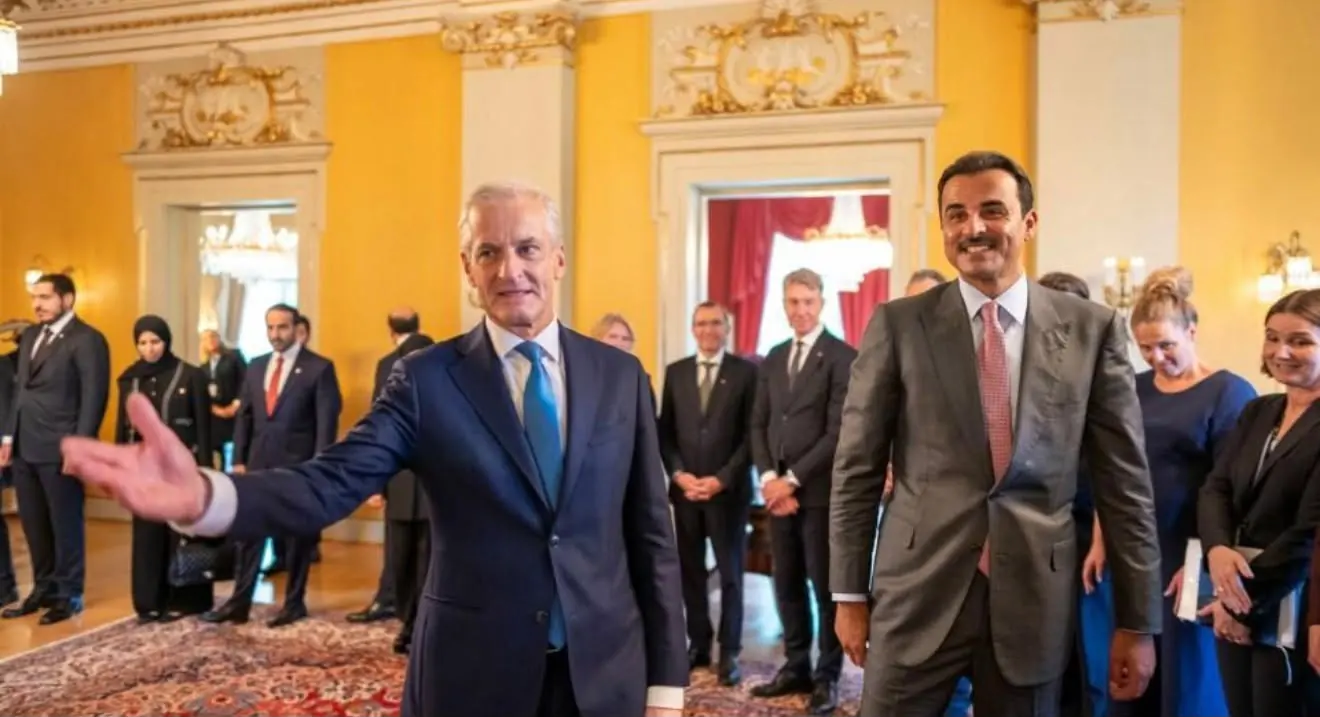
Some diplomatic announcements pass almost unnoticed. And then there are those that deserve a closer look.
Norway’s decision to open an embassy in Doha clearly belongs to the second category.
On paper, this is simply the establishment of a new diplomatic mission. In reality, the signal is much stronger: Oslo recognises that Qatar has become an interlocutor important enough that its relationship with Doha should no longer be managed from a neighbouring regional capital, but directly from Qatar.
This is not a minor detail.
Since establishing diplomatic relations in 1973, Norway and Qatar have developed cooperation in several areas. Until now, Norway’s relations with Qatar were primarily handled from the Norwegian Embassy in Abu Dhabi.
Now, Oslo is choosing Doha.
And this choice comes at a time when Qatar’s international role continues to expand.
Why now?
The answer is actually quite simple: Qatar is no longer merely an energy power in the Gulf.
It has become a country that must be taken into account when it comes to diplomacy, mediation, regional security and international dialogue.
The Norwegian government itself says so quite clearly. In its statement announcing the opening of the embassy, it emphasises that Qatar has become an important international actor in diplomacy and conflict resolution, and that Norway’s engagement with Doha has increased significantly in recent years.
This development is all the more interesting because Norway itself has a distinctive diplomatic tradition: that of a country seeking to play a mediating role, facilitate dialogue and contribute to peace processes.
Norway and Qatar therefore have an obvious area of convergence: the ability to engage with actors who do not always speak directly to one another.
And in today’s world, that ability is extremely valuable.
Just look at recent events: on September 6, only a few days before the announcement of the embassy opening, the Emir of Qatar and Norwegian Prime Minister Jonas Gahr Støre spoke by telephone. The two leaders discussed, among other things, strengthening bilateral relations and international efforts in support of peace and stability.
It is therefore difficult to see the opening of this embassy as merely an administrative decision.
A diplomatic choice, but also an economic one
There is, of course, the political dimension.
But there is also business.
And here again, the Norwegian government is particularly clear: it refers to a long-standing economic partnership with Qatar, with significant potential for expanding and increasing Norwegian exports.
This is probably one of the most interesting aspects of the announcement.
Because the relationship between the two countries is not starting from scratch.
Economic cooperation has existed for many years, particularly in energy and industry. Norwegian companies already have a history in Qatar, and the two countries are now looking to broaden their cooperation into new sectors.
Last May, discussions between Qatari and Norwegian officials focused precisely on investment, trade and strategic projects.
And the sectors highlighted by Oslo today give a clear indication of the direction being taken: energy, the green transition, technology, defence and the defence industry.
In other words, this is not simply about selling more Norwegian products to Qatar.
It is also about building partnerships in sectors where both countries have long-term interests.
Two energy powers that can also talk about the transition
This is probably one of the most interesting paradoxes of this relationship.
Norway and Qatar are two countries whose economies and international influence have historically been strongly linked to energy.
But both also understand that the energy world of tomorrow will not be the energy world of yesterday.
Norway has considerable expertise in offshore technologies, energy, infrastructure and certain green technologies. Qatar, for its part, is investing heavily in diversifying its economy and in new technologies.
The Norwegian government itself identifies the green transition and technology among the sectors where it sees common economic interests.
This is therefore a relationship that could gradually move beyond the traditional “oil and gas” framework.
And perhaps that is where this announcement becomes particularly interesting.
Because an embassy is not simply a flag in front of a building.
It is a permanent presence.
It means an ambassador, a diplomatic team, daily engagement with Qatari institutions, businesses, investors, universities, cultural actors and civil society.
It also means a much greater capacity to support Norwegian companies seeking to enter the Qatari market and, conversely, to facilitate exchanges with Qatari stakeholders interested in Norway.
Diplomacy often opens the door. Business comes next.
A decision that says a great deal about Qatar’s evolution
Ultimately, this is what I take away from the announcement.
For a long time, when Qatar was discussed abroad, the conversation focused mainly on gas, oil, investments or major sporting events.
Today, that is no longer enough to understand the country.
Qatar has become a diplomatic actor in its own right, capable of engaging with very different powers and playing a role in particularly complex international issues.
And when a country like Norway, stable, pragmatic, economically powerful and endowed with a well-established diplomatic reputation decides to strengthen its presence in Doha, it is not simply Qatar that is welcoming a new embassy.
It is also another recognition of the position Doha has acquired on the international stage.
Because diplomacy is not measured solely by the number of embassies a country opens.
It is also measured by the level of trust, interest and expectations that these openings reflect.
And today, Norway has clearly stated that it considers Doha worthy of a permanent, strengthened and forward-looking diplomatic presence.
This is not a small development.
It is, in fact, excellent news for Qatar–Norway relations and an interesting signal of the position Qatar now occupies in the world.
Sihem Souid